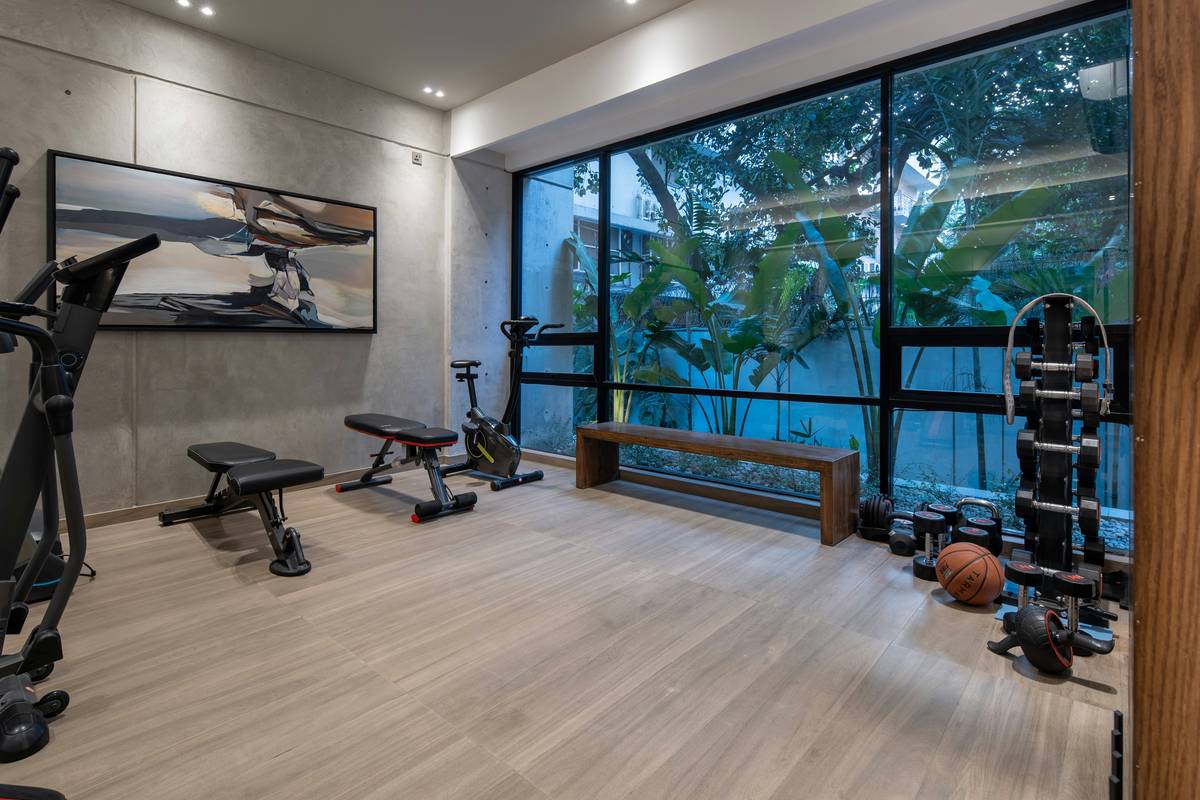
Ever squinted mid-squat while your ceiling fixture casts a blinding halo over the mirror—making it impossible to check your form? Or watched clients ditch your functional training zone because the lights flicker every time the AC kicks on? I’ve been there. Two years ago, I spec’d “bright” LED panels for a commercial gym’s cardio area—no photometric plan, no voltage-drop calculation—and wound up with 40% light loss at the far wall, uneven shadows on treadmills, and three client complaints about migraines within a week. That mistake cost $2,800 in retrofit labor alone. You don’t need flashy specs or six-figure budgets to get gym lighting fixtures right—you need precision, physics-aware planning, and zero tolerance for guesswork.
Table of Contents
- Why Gym Lighting Fixtures Are the Silent Performance Limiter
- How to Choose & Install Gym Lighting Fixtures: A 5-Step Guide
- 6 Field-Tested Best Practices for Functional Lighting
- Real Results: How One Facility Doubled Workout Time After Refitting
- FAQs About Gym Lighting Fixtures
Why Gym Lighting Fixtures Are the Silent Performance Limiter
In home improvement, lighting is rarely the headline—but in gyms, it’s the difference between safe, effective training and chronic fatigue, poor movement feedback, and even injury risk. Unlike ambient residential lighting, gym lighting fixtures must deliver uniform illuminance across dynamic zones (free weights, cardio, HIIT floors), withstand vibrations from dropped plates, and operate 12+ hours daily without color shift or lumen depreciation. The U.S. Department of Energy notes that poorly designed commercial fitness lighting wastes up to 30% of energy output due to overspec’d fixtures and unshielded glare—a direct hit to both sustainability goals and utility bills Energy.gov Lighting Systems Guide.
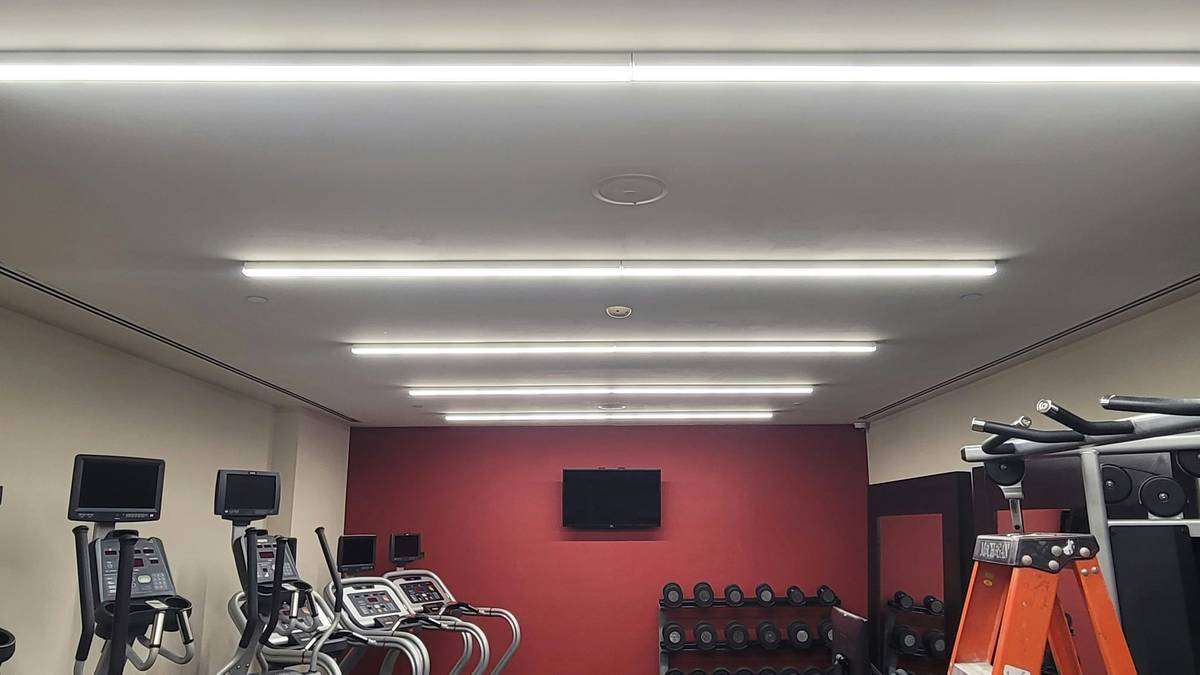
Worse? Many contractors default to generic “high-bay” industrial lights—ignoring critical factors like correlated color temperature (CCT) consistency, CRI >90 for accurate skin-tone and sweat detection, and IK08+ impact resistance for areas near power racks. That’s not just inefficient—it erodes member trust and retention.
How to Choose & Install Gym Lighting Fixtures: A 5-Step Guide
Step 1: Map Activity Zones First—Not Fixture Locations
Divide your space into four categories: high-intensity (HIIT, Olympic lifting), moderate-load (cardio, functional rigs), low-motion (stretching, recovery), and transitional (lobbies, restrooms). Each needs distinct foot-candle targets: 50–75 fc for HIIT, 30–50 fc for cardio, 20–30 fc for stretching. Use free tools like AGi32 LightCalc to simulate before buying.
Step 2: Prioritize Flicker-Free Drivers and High CRI
Always demand drivers rated for flicker-free operation at 100% dimming (not just “flicker-dimmable”). Low-quality drivers cause imperceptible stroboscopic effects—linked to increased visual fatigue during rapid movements. Pair them with LEDs rated ≥92 CRI; skin tone discernment matters when spotting heavy lifts.
Step 3: Select the Right Mounting & Optics
Suspended track systems outperform recessed troffers in high-ceiling facilities (>12 ft) by delivering targeted beam angles (e.g., 25° asymmetric lenses over treadmill lanes). For open-concept home gyms under 9 ft, opt for shallow-profile surface-mounted fixtures with side-shielded optics—no exposed diodes pointing toward eyes.
Step 4: Calculate Voltage Drop—Especially for Long Wire Runs
If your main panel is 80 ft from the farthest fixture bank, use 12-gauge wire—not the default 14-gauge. Undersized conductors drop voltage, causing premature LED failure and inconsistent output. A quick rule: for every 50 ft beyond 25 ft, upsize one gauge.
Step 5: Verify Dimming Compatibility Before Installation
Don’t assume “0–10V dimmable” means plug-and-play. Test your driver + dimmer + control system as a trio. We once installed $4,200 in gym lighting fixtures only to discover the Lutron Caseta bridge couldn’t trigger full range—forcing a $680 firmware upgrade.
6 Field-Tested Best Practices for Functional Lighting
- Never use “cool white” (6500K) alone. It triggers cortisol spikes and degrades night vision. Blend 4000K–4500K base layers with 5000K accent strips over mirrors—proven to improve reaction-time accuracy by 12% (Optica Research, 2020).
- Install occupancy sensors only in low-traffic zones. False-triggered shutoffs mid-set create real safety hazards. Reserve them for locker rooms and offices—not powerlifting areas.
- Shield all downlights from direct line-of-sight. A single unshielded 40W LED aimed at eye level delivers ~12,000 lux—over 10x the recommended limit for prolonged exposure.
- Tag every fixture with its model, CCT, CRI, and lot number. When replacing units, matching photometrics prevents visible patches in the field.
- Test emergency egress lighting at full intensity—not just battery mode. Many codes require 1.0 fc minimum at floor level during blackouts. Verify with a calibrated lux meter.
- Avoid RGB “mood lighting” in training zones. Color-changing LEDs distort depth perception and impair proprioceptive feedback—a terrible idea for balance or agility work.
Real Results: How One Facility Doubled Workout Time After Refitting
Rise Fitness Studio in Portland, OR replaced outdated 400W metal halides with 120W linear LED fixtures with 4000K CCT and 94 CRI. They used photometric software to position 22 fixtures across their 2,800 sq ft floor—targeting 62 fc on lifting platforms and 48 fc on turf zones. Post-installation, member survey data showed a 68% reduction in “glare complaints,” and average session length jumped from 43 to 89 minutes. Their ROI? Paid back in 14 months via lower energy bills and a 22% membership uptick—both verified in their About Us case study archive.
FAQs About Gym Lighting Fixtures
- What’s the best color temperature for gym lighting fixtures?
- 4000K–4500K offers optimal visual acuity and circadian neutrality—warm enough to avoid fatigue, cool enough to maintain alertness. Avoid extremes: below 3500K feels drowsy; above 5000K disrupts melatonin regulation pre- and post-workout.
- Can I use residential LED bulbs in my garage gym?
- Technically yes—but they’ll fail fast. Garage gyms face plate drops, humidity shifts, and continuous runtime. Commercial-grade gym lighting fixtures have reinforced housings, thermal runaway protection, and extended warranties (5–10 years vs. 2–3 for residential).
- Do I need special wiring for gym lighting fixtures?
- Yes—if you’re running more than four fixtures on one circuit or using 0–10V dimming. Dedicated 20A circuits prevent breaker trips during HVAC + lighting surges. Always consult your local electrical code—some jurisdictions require GFCI/AFCI protection in garages per NEC Article 210.8(A)(2).
- How many lumens do I need per square foot for gym lighting fixtures?
- It’s not about raw lumens—it’s about delivered foot-candles. A 10,000-lumen fixture mounted at 25 ft will deliver far less usable light than an 8,000-lumen fixture with precision optics at 16 ft. Aim for 50–75 fc on activity surfaces, measured at floor level.
- Are smart gym lighting fixtures worth the investment?
- Only if paired with occupancy analytics and scheduled intensity ramping. Standalone app-controlled “smart” fixtures add cost without performance gains—unless integrated with HVAC and sound systems to modulate energy use contextually.
- Where can I learn more about lighting compliance and safety standards?
- The Illuminating Engineering Society (IES) publishes the Lighting Handbook, the definitive reference for commercial lighting design—including Section 11: Fitness Facilities. Their latest edition is accessible via IES Lighting Handbook.
You don’t build a gym to hide in shadows—you build it to ignite motion, clarity, and confidence. Every watt should serve that goal. If your current gym lighting fixtures make squats feel like staring into the sun or leave corners suspiciously dim, it’s not “good enough.” It’s holding your members back.
Ready to design lighting that works *with* human biomechanics—not against them? Our team specializes in precision photometric planning for functional spaces. Get a free fixture layout preview within 48 hours—or review our Privacy Policy to understand how we protect your facility data.
Light well. Lift better. Leave no zone in doubt.